
Apache Ossie: The Rename Is Not the Story
OSI is now Apache Ossie (Incubating). The rename is cosmetic. The governance transfer to the Apache Software Foundation is the story — and what it signals for the semantic layer as infrastructure.
Talk to an expertOn July 8, 2026, Snowflake published a short blog post announcing that the Open Semantic Interchange had been accepted into the Apache Incubator under a new name: Apache Ossie (Incubating).
Most of the coverage I have seen treated this as a branding update. A project renamed itself, got a kangaroo mascot, and moved GitHub repositories. Not very exciting.
That framing is wrong. The rename is cosmetic. What actually happened is that the semantic layer standard passed the most important test it could face at this stage of its life: it stopped being something Snowflake owns and started being something no single company owns. That is the story.
What Actually Happened
The proposal to accept Ossie into the Apache Incubator was filed by Jean-Baptiste Onofré in June 2026. The discussion ran on the public Apache incubator mailing list. The formal vote followed. It passed with binding support from across the Incubator PMC.
That process matters. The Apache Software Foundation does not let projects in because the submitting company is well-funded or because the marketing angle is compelling. The bar is governance, not hype. A project enters the Apache Incubator because its structure, licensing, and community development process meet a specific standard for open governance. The discussion is public. The vote is on record. The outcome is not determined by who submitted the proposal.
The timeline is also worth noting. The Open Semantic Interchange repository opened in November 2025. Nine months from launch to the Apache Incubator is fast by any standard. Most successful Apache projects take longer. That speed reflects a deliberate strategy that was visible from the beginning: the initiative adopted Apache-style governance from day one, with Apache 2.0 licensing, a public specification process, and merit-based contribution. By the time the incubation proposal was filed, the governance transfer was a formality, not a renovation.
Why Apache Governance Is the Trust Mechanism That Matters
Every data team I have spoken to over the past six months has asked some version of the same question about OSI: is this really a standard, or is this Snowflake's project that everyone else agreed to participate in?
That skepticism is rational. Snowflake championed OSI from the start. They hosted the working groups, contributed the initial specification framework, and backed multiple companies in the ecosystem through Snowflake Ventures. Their fingerprints were visible everywhere in the early initiative. And when a vendor initiates a "standard," the natural concern is that the standard will bend toward that vendor's interests over time, particularly when the vendor's product roadmap and the standard's roadmap start to diverge.
Apache incubation is the institutional answer to that question. Under ASF governance, the spec changes through public mailing lists, formal discussion windows, and a vote process. Committership is earned through contribution, not through employer affiliation. Snowflake cannot unilaterally change the spec any more than Netflix can unilaterally change Apache Kafka. The governance is the trust, and the governance is now on record.
This is the same mechanism that turned Apache Parquet from "Twitter and Cloudera's columnar format" into the file format every data platform supports. It is the same mechanism behind Apache Iceberg, Apache Kafka, Apache Arrow. Each of those projects entered the ASF with dominant corporate backing. Each graduated as genuinely neutral infrastructure. The pattern holds.
The Historical Parallel Nobody Is Drawing Clearly Enough
There is a useful way to think about what layer of the stack each generation of Apache data standards addressed.
Parquet standardized how we store data at rest. Arrow standardized how we move data in memory. Iceberg standardized how we manage table state and schema evolution. Each of those standards moved competition up a layer. Vendors could no longer differentiate on the format. They had to differentiate on performance, tooling, and integration. Users won because their data became portable.
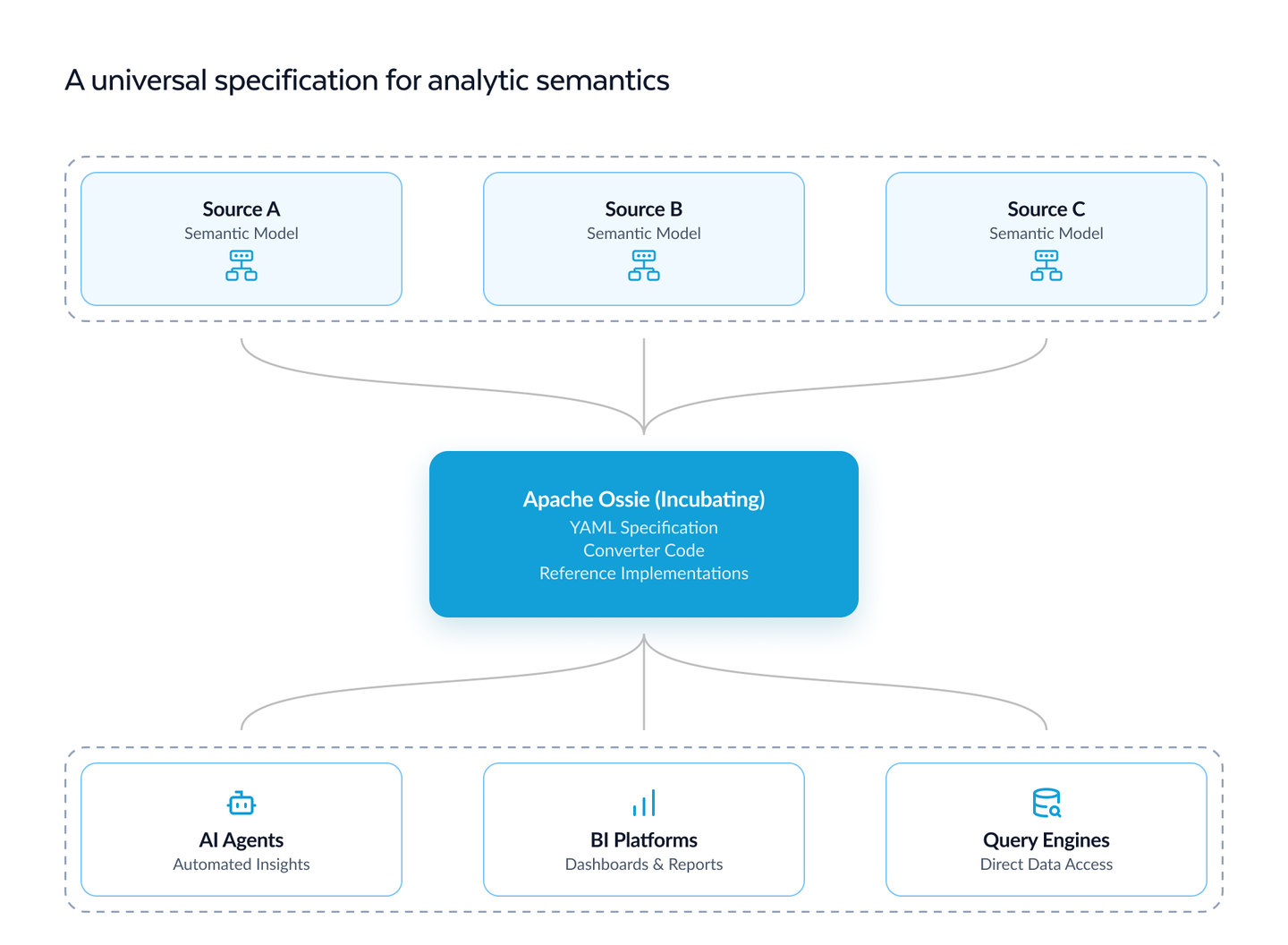
Ossie is attempting the same move one layer higher. It is not standardizing how you store data or how you move it. It is standardizing what the data means: the business logic, the metric definitions, the relationships between concepts that every analyst, every dashboard, and every AI agent has to understand correctly to give a reliable answer.
The arc is one sentence, repeated at ascending layers of the stack: we standardized the bytes, then the files, then the tables, then the catalogs, and now the meaning. Each time, the standard became infrastructure, competition moved up, and users won.
If Ossie graduates from the Apache Incubator and achieves broad adoption, "Revenue" defined in your Snowflake Semantic View will be the same "Revenue" your dbt MetricFlow layer knows, which will be the same "Revenue" your AI agent reasons on when it answers a CFO's question. That portability, at the semantic layer, is what the industry has been missing.
What the Numbers Signal
Nine months of activity before Apache incubation produced: more than 100 commits, 35 merged pull requests, contributors from Snowflake, Salesforce, Databricks, dbt Labs, RelationalAI, GoodData, and Honeydew, three active working groups (Metric Language, Catalog, and Ontology), and a coalition that grew from 17 launch partners to more than 50 organizations.
That last number is the one I keep coming back to. 50 organizations is not a vendor coalition. That is a specification with genuine ecosystem buy-in. The comparison is instructive: the OpenAPI Specification had roughly 40 contributing organizations before it was widely considered a genuine standard. Apache Iceberg had fewer active contributors at the 9-month mark than Ossie does today.
Reference implementations already exist: an Ossie-to-dbt MetricFlow converter, an Apache Polaris catalog metadata converter, and a Snowflake Semantic Model converter. These are not vaporware. They are merged code that lets practitioners evaluate the spec against real workloads. The shift from specification to working implementation is where most standards fail. Ossie has crossed that line.
What This Means for Teams Building Today
If you have been building on Open Semantic Interchange, nothing breaks. The specification is unchanged. The YAML format, the metric definitions, the dimension models — all of it carries forward. The name changed. The spec did not.
But a few things shifted that matter for how you think about Ossie in your data architecture.
The governance question is answered. If your organization was holding back adoption because of concerns about Snowflake's control over the spec direction, those concerns are now addressable through public process. You can read the mailing list. You can contribute code. You can vote on specification changes. The process is on the record.
The relationship with Apache Polaris clarifies the picture. Ossie defines the format of semantic models. Polaris is building the governed catalog where they live and are served. The Ossie-to-Polaris converter is the handshake. This is the same architecture pattern as how Iceberg files relate to a catalog: the file format is one concern, the catalog governance is another, and together they produce something you can actually build on at enterprise scale.
The right 2026 posture is align and experiment, not migrate. The specification is still incubating. The honest answer about production readiness is that first implementations are real, the community is active, and the right move is to start aligning your metric naming and definition structure with the Ossie spec while it matures, rather than waiting for graduation to begin paying attention. Teams that wait for final standards ratification consistently fall 18 months behind the teams that engage during incubation.
What Is on the Roadmap That I Am Watching
The Ossie roadmap is community-decided, not predetermined. But three items stand out as particularly consequential.
A standardized semantic query specification. This is the one that changes the game. Right now, Ossie defines how semantic models are stored and exchanged. A query specification would define how any engine can execute against those models. That is the moment Ossie stops being a file format and becomes a computation protocol. The parallel is not Parquet anymore. It is SQL. If a standardized semantic query spec emerges and gets broad engine support, the vendor lock-in that currently exists at the query layer of the semantic stack evaporates.
Deeper expressiveness for enterprise models. Windowing functions, advanced metric logic, complex relationship modeling. The current spec handles the core cases well. Enterprises with serious modeling requirements need the edge cases handled with the same rigor. This is where practitioners in the working groups earn their weight. The vendors who participate here will shape what "enterprise-grade" means in the Ossie spec.
Apache Polaris integration. Making semantic models discoverable directly from the catalog is the infrastructure piece that enables the end-to-end AI agent scenario: an agent reaches a data platform through a governed MCP surface, the catalog serves it scoped credentials alongside the Ossie-formatted definitions of the metrics it is about to compute, and the agent's SQL encodes your company's definition of churn rather than the model's best guess. That architecture is no longer theoretical. It is what these roadmap items are building toward.
The Gap That Still Needs to Close
Apache incubation resolves the governance question. It does not resolve the adoption gap that I wrote about in our OSI participant guide.
Microsoft is still absent. Power BI is the most widely deployed analytics platform in the world, and its semantic model sits outside the Ossie specification. Until Ossie either integrates with or forces a compatibility decision from Microsoft, a significant portion of enterprise BI workloads will remain outside the standard.
Google Cloud is still absent. Looker invented the modern semantic layer concept through LookML. Google acquired Looker for $2.6 billion specifically because of that semantic layer capability. Their non-participation in a semantic interoperability standard built on top of that concept is conspicuous.
The major AI model providers are still absent. OpenAI, Anthropic, and Google DeepMind are not in the coalition. This matters because the primary driver of semantic layer urgency in 2026 is AI agents querying enterprise data. The case for Ossie is largely a case that AI agents need governed semantic context to avoid hallucinating business logic. The organizations building those agents have not formally committed to the standard that would give their models that context.
Apache governance makes these gaps harder to ignore. A spec in the Apache Incubator with 50+ contributing organizations is a different conversation to have with a holdout than "Snowflake started a working group." The institutional weight has changed.
The Layer That Was Always Missing
I have been writing about the Intelligence Allocation Stack for two years. The thesis is that companies fail at AI not because the models are bad but because they allocate intelligence to the wrong layer of the architecture. They invest in Layer 4 (AI) before fixing Layer 2 (semantic layer) and Layer 1 (data foundation).
The semantic layer's problem has always been a coordination problem. Every team agrees that business logic needs to live somewhere governed and shared. The disagreement is about where, in what format, owned by whom. That disagreement has been an excuse to defer the work.
Apache Ossie does not eliminate that excuse by force. But it changes the terms. The format question now has a vendor-neutral answer with institutional backing and 50 organizations building to it. The owned-by-whom question has an answer: no single company owns it, the community does. The where question is being answered by the Apache Polaris integration on the roadmap.
The excuses are getting harder to sustain. That is what Apache incubation actually means for your data strategy.
Deep dives on modern data engineering
Semantic layers, modern stacks, and scalable architecture — in your inbox, not in a backlog.
Unwind Data
Speak with a data expert
We've helped scale-ups and enterprises move faster on exactly this kind of work — without the trial and error. Strategy, architecture, and hands-on delivery.
Schedule a consultation