
Enterprise AI Data Readiness: What the Research Actually Says
Only 7% of enterprises say their data is completely ready for AI. Here is what the research actually says, and the 4-layer stack diagnostic that shows exactly where your infrastructure breaks before the agents do.
Talk to an expertOnly 7 percent of enterprises say their data is completely ready for AI. That number comes from a March 2026 report by Cloudera and Harvard Business Review Analytic Services, surveying more than 230 leaders directly involved in enterprise ai data readiness decisions inside their organizations. Twenty-seven percent admit their data is not very ready, or not ready at all. The remaining two-thirds sit in the murky middle, where most failed AI projects are quietly buried.
Gartner adds a second data point that sharpens the picture further: through 2026, organizations will abandon 60 percent of AI projects unsupported by AI-ready data. Put those two numbers next to each other and the situation becomes clear. Ninety-three percent of enterprises are not ready. Sixty percent of the projects they launch anyway will be abandoned. This is not a talent problem or a model problem. It is a stack problem.
This post covers what the research actually says about enterprise AI data readiness, where the standard frameworks fall short, and the specific 4-layer diagnostic that surfaces real infrastructure gaps before they become real failures.
Why the Standard Enterprise AI Readiness Surveys Miss the Point
Every major consultancy and technology vendor has published an AI readiness framework in the past two years. Cisco has one. Microsoft has one. Gartner has a maturity model. McKinsey has several. They all follow the same template: evaluate strategy, data, governance, talent, technology, and culture. Assign a score. Produce a report with a traffic light.
Here is the structural problem with that approach. When an enterprise scores "high" on the data dimension of a generic AI readiness index, it typically means: we have a data warehouse, we run some data pipelines, and we have a Chief Data Officer. It does not mean: our AI agents can reliably answer the question "what is our revenue by product line this quarter?" without producing two different numbers from two different tables.
That distinction is everything. And no generic framework captures it.
The Cisco AI Readiness Index identifies only 13 percent of organizations as genuine Pacesetters in AI deployment. The World Economic Forum's 2026 research finds that more than half of business leaders cite data quality and availability as their primary barrier to AI adoption. The EDM Association's 2026 Global Data Management Benchmark finds that only approximately 31 percent of organizations have achieved advanced data strategy capability. The Informatica CDO Insights 2026 study, surveying 600 global data leaders, finds that while 69 percent of companies have integrated generative AI into their business practices, the rapid integration is outpacing the foundational frameworks required for responsible and effective use.
The same organizations keep spending budget on models and agents before they have fixed the infrastructure underneath them. The gap between what surveys measure and what production AI requires is the reason the 7 percent figure feels lower than executives expect. Organizations that believe they have solved the data problem have usually solved the reporting problem. AI requires something categorically different.
Every AI readiness framework published by a vendor has a second structural flaw: it reflects the vendor's technical center of gravity. A data catalog vendor's framework weights metadata management heavily. An infrastructure vendor's assessment scores compute and cloud posture. A governance platform's diagnostic surfaces governance gaps that happen to require a governance platform to fix. This is not cynicism. It is the natural consequence of vendor-funded research. Each framework underweights what it does not measure or sell.
The third flaw is that generic assessments produce a score but not a sequence. A CDO who learns their organization is at Level 2 on a five-level maturity scale knows they are not ready. They do not know which infrastructure layer is broken, in what order to fix it, or what the dependency chain looks like between layers. A layer-specific audit solves all three problems at once.
What Enterprise AI Data Readiness Actually Requires
Strip away the marketing language from every AI readiness framework and four production requirements remain. Every enterprise AI deployment that works has all four. Every one that fails is missing at least one.
Governed data with named owners. Not data that exists somewhere. Data that has an owner, a definition, a lineage that can be traced, and a refresh cadence that is monitored. A spreadsheet on someone's desktop is not governed data. An undocumented Postgres table that only one analyst knows how to query is not governed data. Governance means the data is accountable to someone who is held accountable for it. Deloitte's research on CDO responsibilities in 2026 is direct on this point: the CDO holds enterprise-wide authority over data policy, stewardship, and controls, and is solely responsible for confirming that the organization's data assets are genuinely AI-ready.
A semantic layer machines can actually read. If your definition of "active customer" exists in the head of your VP of Sales but nowhere in your data architecture, no AI agent will give you a trustworthy answer to a question about active customers. It will give you a confident answer. Which is worse. Business logic embedded in BI tool calculated fields, Jupyter notebooks, and ad hoc SQL queries cannot be consumed reliably by autonomous systems. The agent sees the raw data, not the business interpretation. This is the root cause of most AI hallucinations on business data, and it is an infrastructure problem, not a model problem.
Reliable data pipelines with monitored freshness. An AI agent answering questions about last week's data while appearing to answer questions about this week is dangerous in a way that a stale dashboard is not. A dashboard with yesterday's numbers sits in front of a human who might notice the staleness. An agent acting on stale data does not pause to ask whether the data is current. Research published in 2026 estimates that 60 percent of enterprise RAG failures trace to freshness and consistency problems rather than retrieval quality. Teams are spending six-figure budgets on better embeddings while their actual problem is stale documents and broken pipelines.
Access without governance collapse. The biggest unlock for enterprise AI is the ability to read clean, governed data from across the business, on demand, with permissions that respect who is asking. Most enterprise data architectures were built for human analysts making deliberate queries. They were not designed to support autonomous agents making decisions at machine speed. The governance frameworks that work for dashboards break down when an agent can query the same data thousands of times per hour and act on the results without human review.
The 4-Layer Enterprise AI Data Readiness Diagnostic
The framework I use to run these diagnostics is called the Intelligence Allocation Stack. It has four layers, and the order matters because each layer depends on the one below it. Most AI readiness assessments start at the top. This one starts at the bottom.
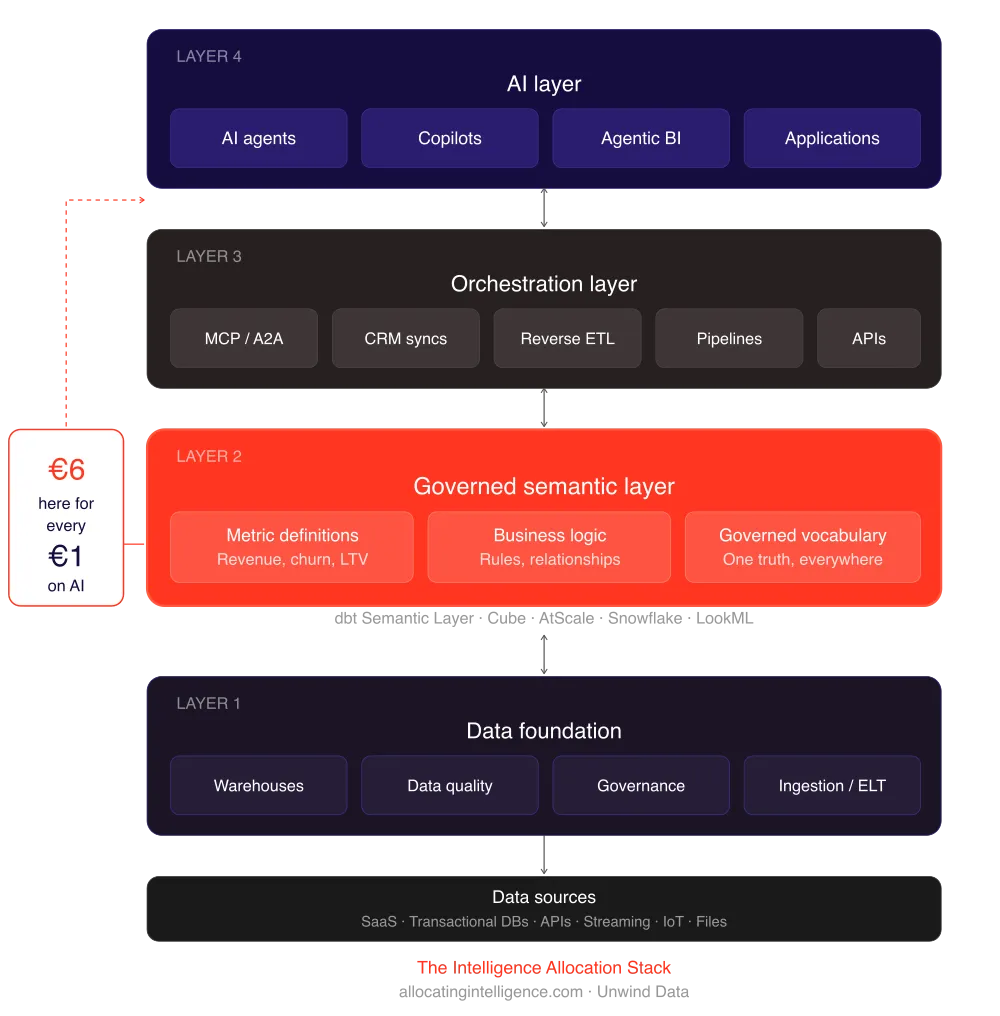
The core principle: for every dollar organizations spend on AI, six should go to the data architecture underneath it. Most enterprises are doing the opposite. Six dollars into the model layer for every dollar into the data foundation. Then they are surprised when the agent gives a confident wrong answer.
Layer 1: Data Foundation
Your data foundation is not just about whether data exists. It is about whether that data is traceable, owned, and trustworthy enough to serve as an AI input without introducing systematic error before the model even runs.
The Layer 1 diagnostic starts with traceability. Can you trace every business-critical metric back to a named source system, with a defined refresh cadence, and a named human owner who is accountable for it? If the answer is no for even three of your top ten metrics, you do not have a data foundation. You have a collection of tables that agrees with itself most of the time and disagrees at exactly the moments it matters most.
Test your single source of truth coverage with a simple exercise. Pick three metrics that matter to the C-suite: revenue, churn, active users. Ask five people across business and data functions to define each one. If you get five different definitions, you do not have a single source of truth. You have five versions of reality, and your AI system will pick one. Usually the wrong one.
Then audit pipeline reliability. What percentage of your data pipelines fail silently? Silent failures are the most dangerous failure mode in AI production: the model keeps running on stale or incomplete data and produces confident-sounding outputs that are factually wrong. A weak data foundation does not produce obvious errors. It manufactures plausible hallucinations.
DATAVERSITY research finds that 62 percent of organizations report incomplete data, and 58 percent cite data capture inconsistencies as a recurring problem. Those gaps are invisible in reporting environments, where a human analyst reviews the output and catches anomalies. They are disqualifying in AI production environments, where the output goes directly to a downstream action or decision with no human in between.
Finally, check data ownership. Every data asset that an AI system will consume needs a named human accountable for its accuracy. Data quality dashboards nobody looks at, data catalogs populated once during implementation and never maintained, governance policies written but not enforced: these are indicators that Layer 1 is documented but not operational. The distinction matters enormously for AI.
Layer 1 passes when every critical data asset has a named owner, data quality SLAs are monitored with automated alerts rather than manual spot checks, pipeline failures surface immediately rather than degrading silently, and there is one authoritative definition for each business-critical metric that every team agrees on. Gartner's estimate that 60 percent of AI projects will fail on data readiness is almost entirely a Layer 1 problem. Fix this layer before touching anything else.
Layer 2: Semantic Layer
This is the layer that every major enterprise AI readiness framework misses. Completely. I have reviewed assessments from Cisco, Microsoft, Gartner, McKinsey, and a dozen regional consultancies. Not one asks whether the organization has a semantic layer. Not one asks whether business logic is centralized or scattered across notebooks and BI tools. Not one asks whether metric definitions are machine-readable and API-accessible for AI consumption.
This is the single biggest blind spot in the enterprise AI data readiness conversation, because the semantic layer is the most differentiating infrastructure component for AI specifically. It is the layer that determines whether AI systems produce trustworthy business outputs or sophisticated-sounding guesses.
Without a governed semantic layer, your AI agents are reading raw SQL tables and constructing their own interpretation of what "revenue" means. Sometimes they get it right. Often they do not. When they get it wrong, the output looks right because it is internally consistent with the wrong definition. You cannot detect the error without already knowing the correct answer. This is what practitioners mean when they describe AI hallucinating on business data: it is not a failure of the model. It is a failure of the infrastructure beneath it.
With a governed semantic layer, AI agents consume pre-validated, business-approved definitions. The finance team's definition of revenue is the same definition the AI agent uses. The divergence problem disappears at the infrastructure level rather than being managed through increasingly complex prompt engineering that grows harder to maintain every quarter.
The Layer 2 audit asks three specific questions. Is your business logic centralized or scattered? Are your metric definitions consistent across every system that consumes them, including BI tools, data science notebooks, and operational databases? Are those definitions machine-readable and API-accessible, or do they live in a Confluence page that only humans can read?
A data dictionary in Confluence is not a semantic layer. A metric glossary in a spreadsheet is not a semantic layer. A governed semantic layer for AI production is one that can be queried programmatically, versioned like code, and consumed by an AI system without requiring a human to translate natural language into correct SQL at runtime. Tools like the dbt Semantic Layer, Looker with LookML, and Omni provide this capability. The specific tool matters less than the principle: business logic must live in a governed, machine-readable layer that exists independently of any single AI application consuming it.
IDC data shows that companies with mature data governance see 24 percent higher revenue from AI initiatives. Almost none of that gap is attributable to the model. It is attributable to the data infrastructure underneath it, and Layer 2 is the most differentiating component of that infrastructure for AI specifically. When I implement a semantic layer for a client before connecting their AI agents, the improvement in output accuracy is immediate and measurable. When clients connect agents without a semantic layer in place, they return three months later with what they describe as a hallucination problem. It is not a hallucination problem. It is a missing Layer 2.
Layer 3: Orchestration Layer
The orchestration layer is the connective tissue between your data foundation and your AI systems. It includes the data pipelines that move data between source systems and the warehouse, the reverse ETL processes that sync enriched data back to operational tools, the workflow automation that triggers actions based on data events, and the API integrations that expose data to AI systems consuming it.
In production AI deployments, orchestration failures account for a significant share of AI errors that get misdiagnosed as model failures. When an AI agent produces inconsistent outputs on the same question asked two hours apart, the cause is usually a pipeline with uneven refresh cadence, not a model that changed its mind. Most debugging effort gets directed at the wrong layer as a result.
The Layer 3 audit starts with pipeline freshness. What is the actual latency between a business event occurring and that event being available for AI consumption? Document the refresh cadence for every data source an AI system will consume, then evaluate whether that cadence matches use case requirements. An agent built for real-time customer experience decisions cannot run on overnight batch data, regardless of how sophisticated the model is. The architecture mismatch is not fixable through better prompting.
Then assess integration coverage. Can your AI system access every source system it needs to answer the business questions it has been deployed to answer? Integration gaps produce a specific failure pattern: the agent does not say "I cannot access that system." It answers based on the data it can see and presents a partial picture as a complete one. In financial reporting contexts, this is the kind of error that surfaces in board reviews rather than in testing environments.
Finally, audit orchestration observability. Can you trace the lineage from a source system record all the way to an AI output? Without end-to-end lineage, debugging AI failures becomes guesswork. Organizations that cannot trace AI outputs back to their data inputs cannot govern those outputs responsibly. That is not a governance policy problem. It is an orchestration architecture problem that no governance framework can paper over.
Layer 3 passes when pipeline latency is documented and validated against use case requirements, every source system the AI needs is integrated with a known and monitored refresh cadence, and there is end-to-end data lineage that connects AI outputs back to their original source records.
Layer 4: AI Layer
This is the layer most CDOs start their readiness assessment with. Which models have we evaluated? What AI vendors are we piloting? Do we have a prompt engineering standard? These are real questions, but they are the last questions to ask in a proper enterprise AI data readiness diagnostic, not the first. Layer 4 assumes you have passed Layers 1 through 3. It asks: given that your data infrastructure is sound, are your AI systems production-ready from a governance, reliability, and accountability perspective?
The failure mode at Layer 4 is categorically different from the other layers. Layers 1 through 3 fail through technical gaps. Layer 4 fails through governance gaps: unclear output ownership, undefined human accountability, absent audit trails, and governance frameworks written for classical AI systems that do not address agentic behavior.
Research published in 2026 found that only 30 percent of organizations have reached maturity level three or higher in agentic AI governance controls. The other 70 percent are scaling agents on a governance foundation designed for a different era, one where humans were the primary data consumers, not autonomous systems acting on business data at machine speed.
The Layer 4 audit starts with output ownership. Who owns the output of your AI agents? When an AI system produces a business metric, a customer-facing recommendation, or an autonomous action, is there a named human accountable for its accuracy and appropriate use? AI governance without named human accountability is not governance. It is liability avoidance documentation that will not survive the first production incident.
Then assess production drift management. Are your AI systems running on the same data distribution in production as they were evaluated against in testing? Data drift is the most common cause of production AI degradation, and it is invisible without active monitoring. A 2025 IBM study found that 71 percent of AI bias incidents in production were caused by biased training data, not biased algorithms. The data changed. The model followed. Nobody noticed until the outputs were already wrong at scale.
If you are deploying AI agents that take autonomous actions rather than just answering questions, the governance requirements are categorically different from classical AI governance frameworks. An agent that can execute code, send external communications, or modify records needs explicit permission scopes, immutable audit logs, and human override mechanisms that can be triggered without disabling the entire system. Most AI governance frameworks written before 2025 do not address this adequately because they were written before agentic AI reached production scale.
DATAVERSITY data shows only 15 percent of organizations have mature data governance overall. For AI-specific agentic governance, that number is lower. The organizations seeing measurable AI impact are the ones that have made governance a first-class engineering concern rather than a compliance exercise executed once per year before an audit.
The Most Common Enterprise Failure Pattern
After running this diagnostic across multiple organizations in fintech, e-commerce, and SaaS, the pattern I see most often is the same every time. Strong Layer 1 foundation on paper. Absent or inconsistent Layer 2. Underinvested Layer 3. A Layer 4 that is trying to compensate for all three gaps through better prompt engineering and model selection.
Prompt engineering is not a substitute for a semantic layer. Better foundation models are not a substitute for reliable data pipelines. AI governance policies are not a substitute for orchestration observability. These are not different approaches to the same problem. They are different layers of the same stack, and no amount of Layer 4 optimization compensates for a broken Layer 2.
The temptation is understandable. The AI layer is where the demos live. The demos are dazzling. The board wants to see them. The competitor down the street is shipping them. So enterprises skip the foundation, deploy at Layer 4, and end up in the 60 percent of AI projects Gartner expects to be abandoned.
I wrote a Medium article in 2019 predicting that every company was about to start hiring Data Engineers to clean up the mess the dashboard era had created. I could rewrite that article in 2026 with almost no edits. In 2019 the mess was BI dashboards built on broken pipelines. In 2022 the mess was data scientists building models on data nobody trusted. In 2026 the mess is AI agents being pointed at warehouses that were never designed to feed them. The pattern does not change. Only the name of the layer at the top does.
This is what allocating intelligence to the wrong layer looks like at enterprise scale. Six dollars on the model. One dollar on the data infrastructure. Then twelve months debugging outputs that could have been prevented with three months of Layer 1 and Layer 2 work done first.
What the Governance Gap Actually Costs
The Cloudera and HBR 2026 report ranks the most critical components of an AI data strategy by priority among enterprise leaders. Protecting sensitive data and privacy comes first at 59 percent. Data quality follows at 46 percent. Data governance lands at 41 percent. Read those three together and you are reading the same requirement three different ways: governance.
This is what changes when you move from dashboards to agents. A dashboard reads data and shows it to a human, who then decides what to do with it. An agent reads data and acts on it directly. The human in the middle is gone. Every weakness in your data governance is now a weakness in your decision-making, at machine speed, at the scale of your entire operation, with no review between the data and the consequence.
The EU AI Act makes this concrete for enterprises operating in Europe. Organizations deploying high-risk AI are required to document training data sources, quality measures, and potential biases. A 2025 Deloitte audit found that only 18 percent of European enterprises could produce complete training data documentation for their AI systems. The governance gap is not just operational risk. It is regulatory exposure that will surface in enforcement, not in internal reviews.
If your current data governance is strong enough for dashboards but not for autonomous systems, the gap will not stay hidden long. An AI agent making purchasing decisions on incomplete vendor data will burn budget before anyone notices. An AI agent answering compliance questions from an ungoverned semantic layer will create legal exposure before legal even sees the question. The 7 percent readiness figure captures only the capability gap. The cost and risk gap is larger.
What a Proper Diagnostic Actually Produces
A properly executed 4-layer enterprise AI data readiness audit produces four specific outputs that a generic AI maturity scorecard does not.
A layer-by-layer gap inventory with specifics. Not "your data governance score is 2.3 out of 5." Specifically: your semantic layer is absent, your metric definitions diverge across three systems, your AI agents are inferring business logic from raw tables without governed context. The specificity is what makes the output actionable rather than decorative.
A remediation sequence that respects the dependency order. You cannot fix Layer 4 governance before you have Layer 2 semantic coherence. You cannot build a reliable orchestration layer on a Layer 1 foundation where source systems have no named ownership. The sequence is a dependency chain, not a preference. Skipping it is the reason 60 percent of projects fail. McKinsey analysis found that organizations with upfront data governance for AI experienced 35 percent fewer post-deployment incidents requiring remediation than those that added governance reactively.
A use-case-specific readiness map. The assessment answers "is your data infrastructure ready for this specific AI use case?" not "is your data ready for AI in general?" Those are different questions with different answers. A data strategy that is fully ready to support AI-powered customer churn prediction may be entirely unready to support an AI agent answering ad hoc financial questions. The layer-specific audit surfaces this at the use-case level, before engineering resources are committed to a use case the infrastructure cannot yet support.
A data infrastructure investment roadmap. Not a score to present to the board. A sequenced plan that translates assessment findings into engineering work: which layer to fix first, which infrastructure investments unblock the most AI use cases, and what the critical path looks like from current state to production readiness.
How to Run This Diagnostic in Your Organization
The most efficient entry point is not a comprehensive audit of all four layers simultaneously. Start with your three most business-critical AI use cases. For each one, trace the data requirements backward through all four layers. Identify the lowest layer where the chain breaks. That is your highest-priority remediation target.
For a revenue analytics AI agent: does a governed definition of revenue exist in a machine-readable semantic layer? No? That is a Layer 2 gap. It is the highest-priority fix before you do anything else on that use case. Everything above it depends on it.
For an AI-powered customer support agent: does it have access to real-time customer data, or is it running on overnight batch data? Latency mismatch is a Layer 3 gap that will produce wrong answers to time-sensitive questions regardless of how well the model was trained or how well the prompts are written.
For an agentic AI system that takes autonomous actions on business data: are there named owners for each action type, explicit permission boundaries, and immutable audit logs? No? That is a Layer 4 gap that makes the system ungovernable regardless of how sound the data infrastructure underneath it is.
The pattern holds across use cases and industries. Fix the lowest broken layer first. Work up. Never reverse the order. Start at one, not at four.
The CIOs and Heads of Data who are quietly pulling ahead in 2026 are making a different choice than their peers. They are slowing down the AI rollout to speed up the data foundation. They are spending budget on dbt, Snowflake, BigQuery, Looker, and their orchestration layer before spending a euro on agents. They are picking governance vendors for the long game, not the demo. They are making the work boring on purpose, because boring work is the only kind that compounds.
The World Economic Forum's 2026 research found that 72 percent of business leaders will prioritize data foundations and pipelines in the next twelve months. The enterprises that acted on that priority a year ago are the ones shipping AI that works in production. The ones acknowledging it now are twelve months behind. That gap compounds.
What Enterprise AI Data Readiness Looks Like When It Works
The 7 percent of enterprises that have figured this out are not doing anything exotic. They are doing something boring. They audited their data pipelines before deploying agents. They centralized their metric definitions in a versioned semantic layer that lives in code. They defined data ownership before they defined AI use cases. They built AI agent governance frameworks specifically for autonomous systems, not borrowed frameworks written for dashboards and classical models.
The result is AI that moves a real number on the income statement. Not pilots that get quietly deprecated six months after the announcement. Not learning experiences that consumed eighteen months of engineering capacity and produced a slide deck. AI that answers the same business question the same way three times in a row, at scale, in production, without a human reviewing every output before it reaches the decision.
Companies with mature data governance see 24 percent higher revenue from AI initiatives according to IDC research. The Deloitte 2026 State of AI in the Enterprise report shows that only 20 percent of organizations are already generating revenue growth from AI, while 74 percent still list it as a future aspiration. That gap between the 20 percent generating revenue and the 74 percent aspiring to is not a model capability gap. It is a data infrastructure gap, and it is measurable at the layer level with the right diagnostic.
Systems beat individuals at scale. That rule has held across every wave of enterprise technology, and AI is not the exception. It is the loudest example yet of what happens when organizations allocate intelligence to the wrong layer.
The Question Every CDO Should Ask This Quarter
If you are sitting inside an enterprise investing in AI right now, the right question is not which model to use. The question is whether your data foundation could survive that model being pointed at it.
Could your data pipelines feed an agent every five minutes without breaking? Could your semantic layer answer the same business question the same way three times in a row? Could your data governance survive an autonomous system making a decision your legal team has not approved?
If the answer to any of those is no, you are in the 93 percent. The path out is well understood. Fix the floor before you let the agents run. Start at Layer 1, not Layer 4. Allocate intelligence to the layer that actually needs it, which is almost never the one running the demo.
Seven percent of enterprises have figured this out. The other 93 percent will, eventually. The only question is how much of this year's AI budget they burn before they do.
If you want to run this diagnostic with a practitioner who has worked across fintech, e-commerce, and SaaS data stacks, that is what Unwind Data does. Not as a vendor selling a platform. As an independent consultant with no product to recommend. You can learn more about the enterprise AI readiness assessment, or read how to build an AI-ready data foundation from the ground up before your next agent deployment.
More on Data Foundation
Get actionable insights on this topic — and more — straight to your inbox. No fluff.
Unwind Data
Speak with a data expert
We've helped scale-ups and enterprises move faster on exactly this kind of work — without the trial and error. Strategy, architecture, and hands-on delivery.
Schedule a consultation