
The dbt Fivetran Merger: What It Means for Your Data Stack
80-90% of Fivetran customers already used dbt. The merger formalized what most data stacks were already doing — but the implications for open source, the Iceberg bet, and the semantic layer are worth thinking through carefully.

The deal that formalized what most stacks were already doing
The dbt Fivetran merger is the data industry's biggest consolidation move in years — and if you felt like it was inevitable, you were reading the signals correctly.
On October 13, 2025, Fivetran and dbt Labs signed a definitive agreement to merge in an all-stock deal. Under the agreement, George Fraser serves as CEO of the unified company, and dbt Labs CEO Tristan Handy serves as co-founder and President. The combined company is approaching $600M in annual recurring revenue.
The data community reacted with a mix of excitement, concern, and — if we are being honest — a quiet sense that this was always inevitable. An estimated 80–90% of Fivetran's customers already use dbt's tools. This isn't a cross-sell opportunity — it's an acknowledgment that the Extract-Load-Transform (ELT) pattern we've all been running is inherently integrated work that was artificially separated across vendors.
That is the most important sentence in the entire story. Not the valuation. Not the leadership structure. The 80-90% overlap number. Two products that most practitioners already used together are now formally one company. That is not a bet on synergies. It is a recognition of reality.
What actually happened, and what led here
To understand the merger, you have to look at the six months that preceded it. Fivetran did not just acquire dbt Labs. It went on an acquisition run that, in hindsight, was building toward exactly this outcome.
May 2025: Fivetran acquires Census — the reverse ETL platform that sends transformed data back into operational tools like CRMs, ad platforms, and customer success tools. Fivetran now owns inbound data movement.
September 2025: Fivetran acquires Tobiko Data, the company behind SQLMesh and SQLGlot. SQLMesh is a dbt competitor with a different approach to transformation architecture. SQLGlot is a cross-dialect SQL parser used across the data ecosystem. It was Fivetran's third merger or acquisition in six months. Among the things Census, SQLMesh, SQLGlot, and dbt Core have in common is their open-source nature.
October 2025: Fivetran merges with dbt Labs.
The pattern is not accidental. Fivetran was systematically assembling the full data lifecycle under one entity: extract and load (Fivetran core), transform (dbt, SQLMesh), activate back to tools (Census), with open-source SQL parsing infrastructure underneath it all (SQLGlot). Together, they cover nearly the entire data lifecycle, from source to warehouse to activation.
The dbt merger was the anchor piece. Everything else was scaffolding around it.
Why this merger happened now
The timing is not coincidental. It reflects where competitive pressure was coming from.
Snowflake, Databricks, Microsoft Fabric — they're all building full-stack solutions. The merger is Fivetran and dbt's answer: if you can't beat the platforms, become one yourself.
The modern data stack was built on the idea that best-of-breed modular tools, connected together, would outperform monolithic platforms. For several years that was true. Fivetran moved data reliably. dbt transformed it elegantly. Looker or Tableau visualized it. You assembled the stack yourself.
The platforms disagreed with this architecture and spent the last three years proving it. Snowflake built Cortex and the Universal AI Catalog. Databricks built Unity Catalog and notebook-native ML. Microsoft wrapped everything in Fabric. Each one offering to do more of the stack natively, with tighter integration, at potentially lower total cost.
The modern data stack's response is this merger. Fivetran and dbt are no longer "two of your tools." They are now positioning as the open-source counterweight to the proprietary platform build-out — an open data infrastructure that unifies data movement, transformation, metadata, and activation while preserving freedom of choice for analytic compute and AI. Built on open standards like SQL and Iceberg, flexible so organizations avoid lock-in and can scale with future workloads.
The Iceberg bet is the most important strategic signal
Most commentary on this merger focuses on the Fivetran + dbt integration story. That is the obvious narrative. The more important signal is what George Fraser wrote in his announcement post about strategic priorities.
The stated number one priority is making it easy for every customer to adopt data lakes based on open table formats and catalogs. Iceberg is described as a revolution that enables you to truly get all your data in one place that serves every workload. Fivetran and dbt are positioned as uniquely able to help customers make this transition seamlessly.
This matters because Apache Iceberg is the emerging open table format for data lakes. If Iceberg becomes the default substrate for enterprise data, whoever controls the pipelines that feed it (Fivetran) and the transformation layer that structures it (dbt) controls enormous leverage in the stack.
The Fivetran + dbt + Iceberg combination creates a potential path where enterprises run their data lake on open formats, use Fivetran to move data into it, dbt to transform it, and keep Snowflake or Databricks as a query engine rather than as the data owner. A customer runs Fivetran and dbt jobs on Snowflake today. Tomorrow, they could potentially shift computation to Iceberg-based storage while keeping results queryable in Snowflake via its Iceberg support — meaning massive savings on Snowflake compute bills.
That is a direct challenge to Snowflake's business model. It is probably not an accident.
What this means for three types of data teams
The practical implications differ depending on where you sit.
If you already use both Fivetran and dbt: The near-term experience is non-disruptive by design. dbt will still be dbt. Fivetran will still be Fivetran. No plans to rename either product, no disruptive product changes, continued support for the dbt Community, and aggressive execution against respective product roadmaps. The interesting question is what they can now build together. The deal opens the door to features that weren't practical before: integrated pipeline monitoring, transformation-aware scheduling, and stronger support for semantic modeling. Shared metadata, consistent lineage, and coordinated testing from end to end. Those are real improvements that practitioners have wanted for years. Pay attention to the product roadmap over the next 12 months.
If you use dbt but not Fivetran: Nothing changes today. dbt Core stays open source — this was explicitly committed to. dbt Core and Fusion will both continue to be shipped under their current licenses. Fivetran has been a long-time contributor to the dbt open source ecosystem, authoring over 100 packages with OSS licenses used by thousands of teams. The concern worth monitoring is whether platform features gradually migrate from dbt Core to dbt Cloud as the combined company optimizes for revenue. That tension between open-source stewardship and commercial growth is the real risk, not an immediate product change.
If you use Fivetran but have been evaluating alternatives: The merger does not change your immediate evaluation criteria. Fivetran's connector breadth and reliability are still what they were. What changes is the long-term trajectory: you are now evaluating Fivetran as part of a broader data infrastructure platform. Factor in where that platform is headed, not just where it is today.
The open source question nobody can fully answer yet
This is the tension at the center of the merger, and anyone who says they know how it resolves is guessing.
Fivetran is not open source. It remains to be seen whether the combined company continues to support dbt's open source platform and community with the same commitment dbt did as an independent entity, despite a promise that dbt Core will remain open under its current license. "dbt has a very strong user base on the free product, so the potential drawback is Fivetran's commitment to dbt Core."
The commitment is real and on the record. But commitments made in merger announcements exist in a different environment than commitments made under growth pressure from investors eyeing an IPO. The combined company's path to an IPO almost certainly requires monetizing the dbt user base more aggressively than dbt Labs could as an independent company.
The pattern to watch: how does the feature split between dbt Core and dbt Cloud evolve over the next two years? If the Core/Cloud boundary stays roughly where it is today, the commitment is holding. If meaningful features that used to be in Core start landing exclusively in Cloud, that is the signal that commercial pressure is winning.
The SQLMesh question nobody is asking loudly enough
Fivetran now owns SQLMesh, which is a direct architectural competitor to dbt. SQLMesh offers a different approach to transformation: native SQL understanding, incremental model evaluation, and cross-dialect compatibility via SQLGlot. Some teams evaluating dbt alternatives have been looking at SQLMesh specifically because it handles certain transformation patterns more elegantly.
Fivetran already owns SQLMesh, which is actually a dbt competitor with some more advanced features. The question is whether they bought SQLMesh for the technology and dbt for the customer base.
The most honest answer is: probably both. SQLGlot's cross-dialect SQL parsing is genuinely valuable as infrastructure for any tool that needs to run SQL against multiple engines. SQLMesh's transformation architecture may inform future dbt Fusion development. Or SQLMesh may quietly languish as dbt gets all the investment.
If you are currently building on SQLMesh, this is worth watching. The development trajectory of a product owned by a company that also owns its main competitor is not guaranteed to be independent.
The semantic layer angle: where this gets interesting for data teams
Here is the implication that has not been discussed enough in the merger coverage.
The dbt Semantic Layer (MetricFlow) defines business metrics as code — revenue, churn, conversion rate — in a way that is version-controlled, testable, and portable across BI tools. That is Layer 2 in the data stack: the governed business logic layer between raw warehouse tables and the tools that consume them.
Fivetran with Census now handles both inbound data movement (Layer 1 ingestion) and outbound activation (reverse ETL back to operational tools). dbt handles transformation and semantic modeling.
Together, the combined entity covers Layer 1 through Layer 2 end-to-end. The ELT pattern — from source, through warehouse, through transformation, through semantic definition, to activation — is now a single platform play if you choose to use it that way.
For teams that have been building this stack piecemeal, this creates a meaningful simplification opportunity. For teams that have been delaying the semantic layer because it added another vendor to manage, that barrier just dropped. dbt's MetricFlow is already part of your transformation layer. The semantic layer is now bundled, not bolted on.
If you want to understand how the dbt Semantic Layer compares to other approaches like Cube, that context is worth having as you think through where this merger leaves your stack.
What to do with all of this
The immediate answer is: nothing disruptive. If you use and love either product today, this merger is designed to be non-disruptive.
But the medium-term implications are worth building into your infrastructure planning now.
If your stack runs on Fivetran and dbt, the investment case for going deeper on the dbt Semantic Layer just improved. You are no longer adopting a standalone semantic layer tool — you are using a feature of the transformation platform you already pay for, with tighter integration coming as the combined company builds shared metadata infrastructure.
If your stack runs on Snowflake or Databricks as the primary platform, watch the Iceberg strategy closely. The open table format bet is a direct challenge to platform lock-in. Organizations that stay on a single platform indefinitely are the ones most exposed to this consolidation trend.
And if you are evaluating your data architecture from scratch in 2026, the build-vs-buy calculus has shifted. The modern data stack assembled from independent best-of-breed tools is still valid. But the consolidation is real and accelerating. Plan your architecture with that trajectory in mind, not just where the tools are today.
The 80-90% overlap was always the most honest data point in this story. Most teams were already treating Fivetran and dbt as one tool. Now they formally are. The interesting part is what gets built next.
More on Data Foundation
Get actionable insights on this topic — and more — straight to your inbox. No fluff.

More from Unwind Data
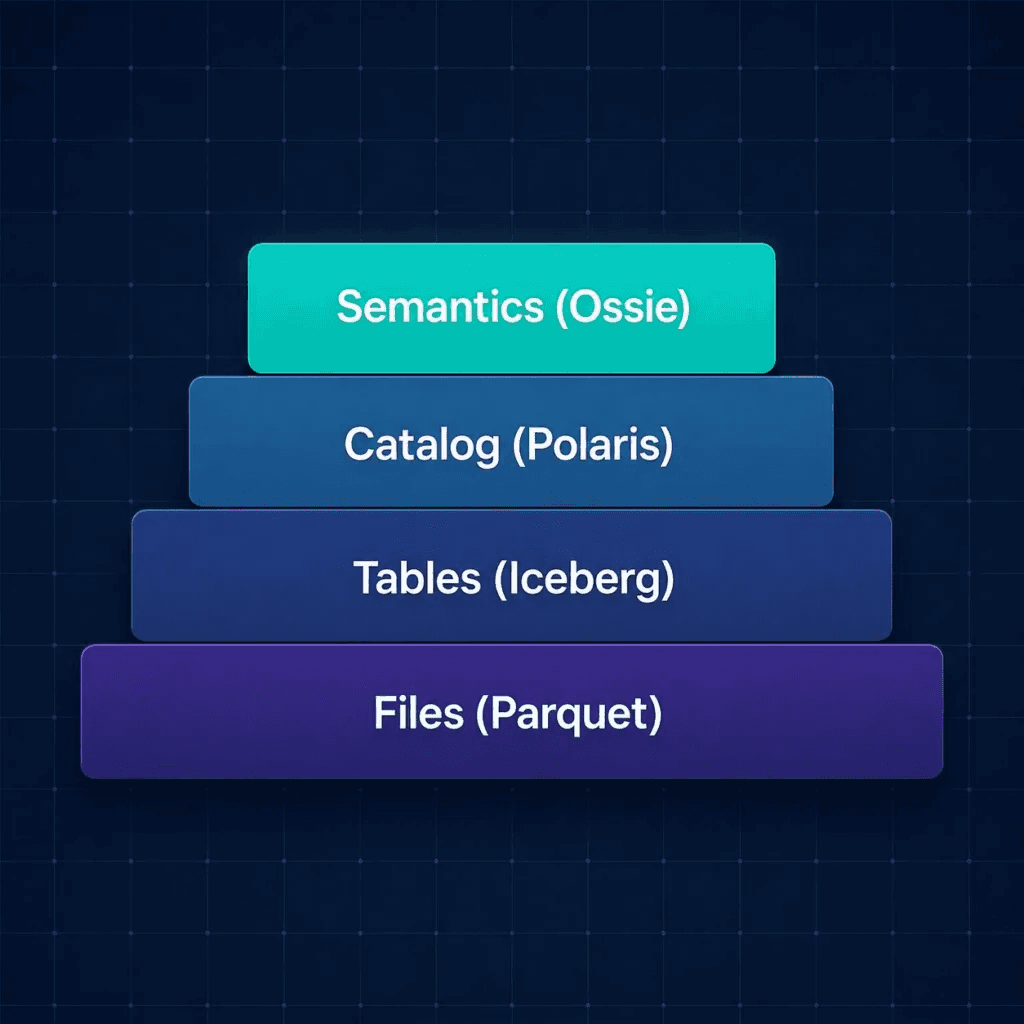
The Open Data Stack: Parquet, Iceberg, Polaris, Ossie
Apache Parquet, Iceberg, Polaris, and Ossie now cover every layer of the data stack with open, vendor-neutral standards. Here is what each layer does, how they compose, and what it means for AI-ready data architecture.
Data Foundation for AI: What to Build Before the Model
Most AI projects fail before the model is ever the bottleneck. The real problem is the data foundation underneath. Here is what it takes to build one that actually supports production AI.

Enterprise AI Is Stalling on a Data Foundation Almost Nobody Has Built
Only 7% of enterprises say their data is completely ready for AI. The Cloudera and HBR 2026 report confirms what the 60% AI project failure rate has been screaming: the bottleneck is the data foundation, not the model.
Ready to unlock your data potential?
Let's talk about how we can transform your data into actionable insights.
Get in touch